
What Concrete Leveling Is
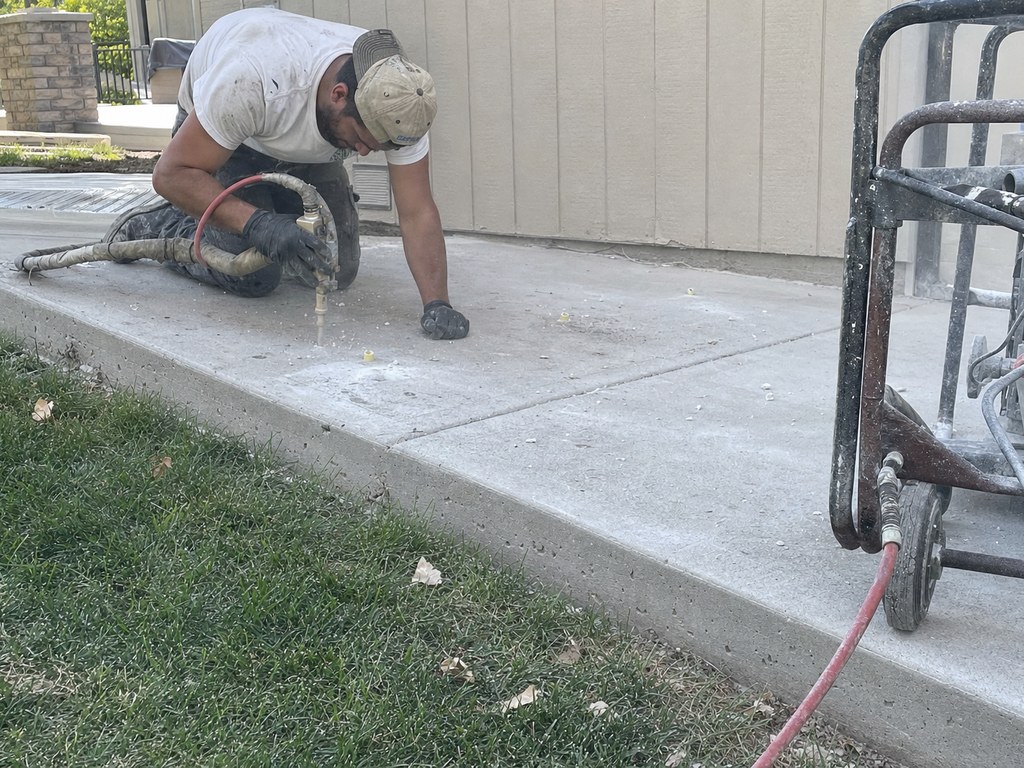
Concrete leveling, also called concrete lifting or concrete raising, brings a sunken slab back up to its original height without replacing it. We drill small injection ports through the surface, pump material underneath to fill the empty space, and use that pressure to raise the slab evenly to grade. The concrete you already have stays put. We are just putting the support back beneath it.
People call it a lot of things. Slabjacking, mudjacking, foam lifting, void fill. They all describe the same basic idea: the slab did not fail, the ground under it did, so we fix the ground and let the slab settle back where it belongs.
Why Slabs Sink in the First Place
A concrete slab is only as stable as the dirt holding it up. When that base moves or disappears, the slab drops. Around Stockton we see the same handful of causes over and over.
- Soil settling. Fill dirt that was never fully compacted keeps compressing for years after the pour. The slab rides it down.
- Soil washout and voids. Poor drainage sends water under the concrete, and that water carries fine soil away with it. Over time you get hollow voids under the slab with nothing to hold the weight.
- Poor compaction. If the subgrade was rushed before the original pour, it settles unevenly and one corner sinks faster than the rest.
- Expansive clay movement. The Central Valley is full of expansive clay. It swells when it gets wet and shrinks when it dries out, and that constant heave and drop works a slab loose season after season.
If you want the longer version of why our local ground is so hard on concrete, we broke it down here: why concrete cracks in Stockton.
The Methods We Use
Polyurethane Foam Injection
Polyurethane foam injection is our go-to for most jobs. We drill dime-sized ports, inject a two-part foam that expands under the slab, and that expansion fills every void and provides hydraulic lifting pressure to raise the concrete. The foam is lightweight, so it does not add load to soil that is already weak, and it is waterproof, so it will not wash out the way older materials can.
Mudjacking and Slabjacking
Mudjacking, the traditional slabjacking method, pumps a cement-based slurry under the slab to fill the space and float it back up. It is a proven approach and can be the right call on heavier slabs or where the budget favors it. The slurry is heavier than foam and the ports are larger, so we walk you through the trade-offs when we quote the job.
Grinding a Trip Lip
Sometimes a slab has only settled a little and the real problem is the sharp trip hazard where two sections meet. In those cases grinding the raised edge down flush can solve the safety issue without a full lift. It is the simplest fix on the menu and we will tell you honestly when it is all you need.
The Process, Start to Finish
Every lift follows the same clean sequence. First we drill a pattern of small injection ports through the sunken slab. Then we inject the foam or slurry, watching the concrete rise as the material fills the voids beneath it. We lift in controlled stages until the slab is back to grade and sits flush with the sections around it. Finally we patch the ports so the surface is smooth and the repair blends in. No heavy demolition, no forms, no waiting on a new pour to cure.
What We Can Level
If it is a slab on grade, we can usually raise it. Our crews level driveways, walkways and sidewalks, patios, garage floors, pool decks, and porch steps across San Joaquin County. Sunken driveways and walkways are the calls we get most, since those are where a settled edge becomes a daily trip hazard for the whole family.
Leveling vs. Replacement
Leveling is the right move when the slab itself is still sound and the problem is underneath it. If your concrete has settled or developed voids but the surface is intact, lifting saves you money and gets you back on it same day.
Replacement makes more sense when the slab is badly broken up, crumbling, or cracked past the point where lifting would hold. A slab that has shattered into several pieces will not raise cleanly, and at that stage a fresh pour is the honest answer. When it comes to that, we also handle concrete removal and replacement so you are not juggling two contractors.
There is also a middle ground. A slab can be structurally fine but have a working crack that needs sealing, or surface damage that calls for concrete repair rather than a lift. If you are dealing with a specific split in a driveway, our driveway crack repair service pairs well with leveling, and for larger structural slabs our slab repair work covers the concrete itself. We look at the whole picture and recommend the least invasive fix that will actually last.
Cost Factors
What a lift costs depends on the size of the slab, how far it has to rise, how many voids we are filling, and whether we use foam or a cement slurry. Access matters too, since a tight backyard pool deck takes more setup than an open driveway. The one constant is that leveling almost always costs less than tearing out and repouring the same slab, often a fraction of the price. We give you a free itemized estimate up front, broken out line by line, so there are no surprises when the work is done.
Timeline and Return to Use
Most leveling jobs are a same-day job. With polyurethane foam injection the material sets fast, so you can typically walk on the surface within an hour or so and drive on it not long after. Mudjacking needs a little more cure time before heavy loads go back on. Either way you are looking at hours, not the days a replacement pour would tie up your driveway.
Stockton Considerations
Local ground drives how we approach a lift. Our expansive clay swells and shrinks with the seasons, so we look at drainage before we level anything, because a slab that sank from soil washout will just sink again if the water keeps running under it. We fill the voids and, where it helps, point you toward the grading or downspout fix that keeps the base dry. Leveling the slab is the visible part. Solving the reason it dropped is what makes the repair hold in Stockton.
Why Lift Instead of Replace
Lifting keeps the concrete you paid for, costs less, and gets you back to normal in a single visit with almost no mess. There is no demolition dust, no new slab that takes weeks to cure and match, and no wondering whether the fresh pour will settle the same way the last one did. When a slab is sound and simply sitting too low, raising it is the smart, straightforward fix, and it is the one we recommend whenever the concrete will support it.